
In the B2B world, it is easy to treat a stainless steel fastener as a simple commodity. But here is the reality: whether you are dealing with a bolt, nut, washer, or rivet, these components are the only things standing between a successful project and a catastrophic structural failure.
If you are only looking at the “304 vs. 316” label, you are missing 90% of the engineering story. From machine screws in medical devices to self-tapping screws in solar arrays, high-performance fastening requires a deep dive into metallurgy and stress physics.
1. The “Invisible” Defender: Understanding PREN
People often ask why one stainless bolt rusts in months while another lasts decades. The answer is a mathematical value called the Pitting Resistance Equivalent Number (PREN).
Stainless steel isn’t invincible; it relies on a chromium-oxide “passive layer” that is only a few atoms thick. In high-chloride environments (salt spray), this layer is under constant chemical attack.
The Formula:
PREN = \%Cr + 3.3 \times \%Mo + 16 \times \%N
- SUS304 (A2 Grade): With a PREN of roughly 18, it is perfect for indoor furniture or automotive trim. However, it lacks Molybdenum, making it vulnerable to “pitting” once chloride levels exceed 200 mg/L.
- SUS316 (A4 Grade): By adding 2–3% Molybdenum (Mo), the PREN jumps to 24+. This is the baseline for industrial equipment and coastal construction.
The Pro Tip: If your project is within 5km of the ocean, using 304 isn’t “saving money”—it’s scheduling a future failure.
2. The “Cold Weld” Nightmare: Why Bolts Seize (Galling)
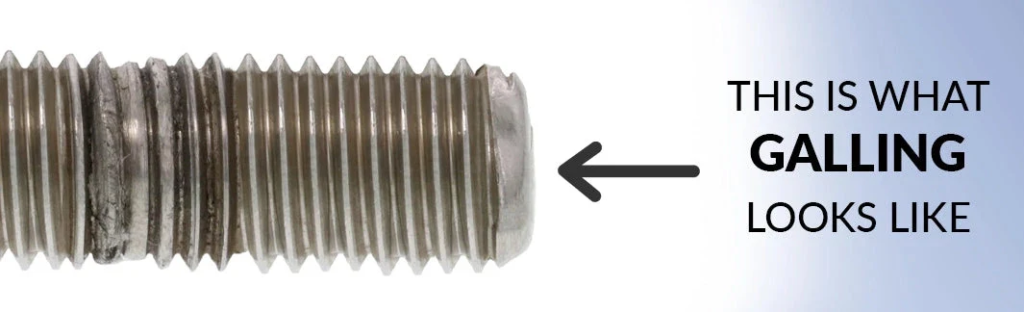
Have you ever had a SUS316 bolt freeze halfway into a nut? It won’t move in or out, and you eventually have to saw it off. This is gallant.
Because austenitic stainless steel is relatively ductile (“soft”), the friction of high-speed installation generates heat that breaks the protective oxide layer. The bare metal atoms then “weld” together instantly.
The Engineering Solution:
- The Hardness Gap: Don’t use the same hardness for both parts. Pair an A4-80 bolt (high strength, $800 \text{ MPa}$ tensile) with an A4-70 nut. That slight difference in Brinell hardness (approx. 30–50 HBW) prevents the threads from interlocking.
- Lubrication is Non-Negotiable: Use anti-seize compounds like Molybdenum Disulfide ($MoS_2$) or specialized PTFE coatings to drop the friction coefficient from a dangerous 0.30 to a safe 0.10.
3. The “Weakest Link” Strategy: Washers, Rivets, and Screws
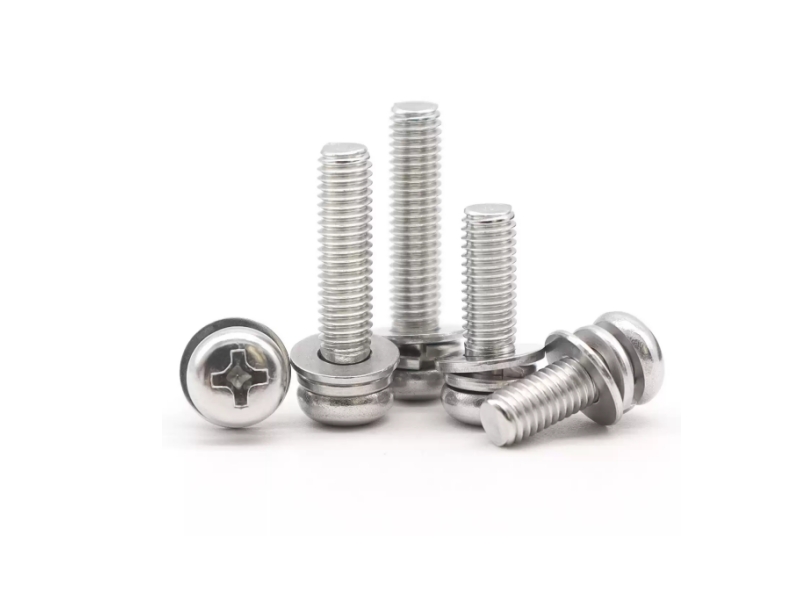
The Washer Trap
Never use a 304 washer with a 316 bolt. In a corrosive environment, the lower-grade material will act as a “sacrificial anode,” corroding rapidly and causing the entire assembly to lose its clamping force (preload).
Why Self-Tapping Screws “Snap Heads”
In the solar and construction industries, we often see self-tapping screws snap off during or after installation. This is usually due to Intergranular Corrosion (IGC).
The Science: If the steel isn’t cooled correctly during manufacturing, chromium carbides precipitate at the grain boundaries. This leaves “starved” areas that are no longer stainless. The screw looks fine on the outside, but it is structurally “brittle” on the inside.
High-Precision Rivets
In aerospace or heavy automotive work, a rivet must undergo massive deformation without cracking. This requires strict control of sulfur and phosphorus levels in the melt to ensure continuous grain flow.
4. The 2026 Shift: Carbon and Compliance
The B2B procurement landscape has fundamentally changed. In 2026, a “quality” fastener must also be a “compliant” fastener.
- CBAM (Carbon Border Adjustment Mechanism): For exports to Europe and other regulated zones, the “Carbon Footprint” of your steel is now a line item. Fasteners made via Electric Arc Furnaces (EAF)—which use recycled scrap—have a 60% lower carbon intensity than traditional blast furnace routes.
- MTR Traceability: A professional Material Test Report (MTR) is no longer optional. It must link the steel’s specific heat number to the finished batch of bolts or screws to ensure that no “alloy down-specing” occurred at the factory.
5. Final Audit: The Expert’s Checklist
Before you sign off on a major procurement order, verify these four technical pillars:
- PREN Alignment: Does the alloy match the environment? (C5-M environment = PREN 24+).
- Mechanical Class: Are you using A4-80 for structural loads? (Don’t settle for A4-70 if the design requires $800 \text{ MPa}$ tensile strength).
- Magnetic Permeability: While 300-series is “non-magnetic,” cold-working into machine screws creates “Deformation-Induced Martensite.” If you are building sensitive electronics or MRI machines, you must specify Solution Annealing to remove magnetism ($\mu \le 1.01$).
- Galvanic Isolation: If mounting stainless steel to aluminum, have you included [Isolation Gaskets or Bushings] to prevent bimetallic corrosion?
Conclusion: Precision Over Price
In 2026, the most expensive fastener is the one that fails. By understanding the metallurgy of pitting, the physics of galling, and the requirements of carbon compliance, you move from being a “buyer” to an “engineer of reliability.”
Need a specific corrosion rate table or a deep dive into high-temperature alloy stability? Contact our technical engineering team for a consultation.
Contact us at +86 13451555650 or sales@szbilateral.com.