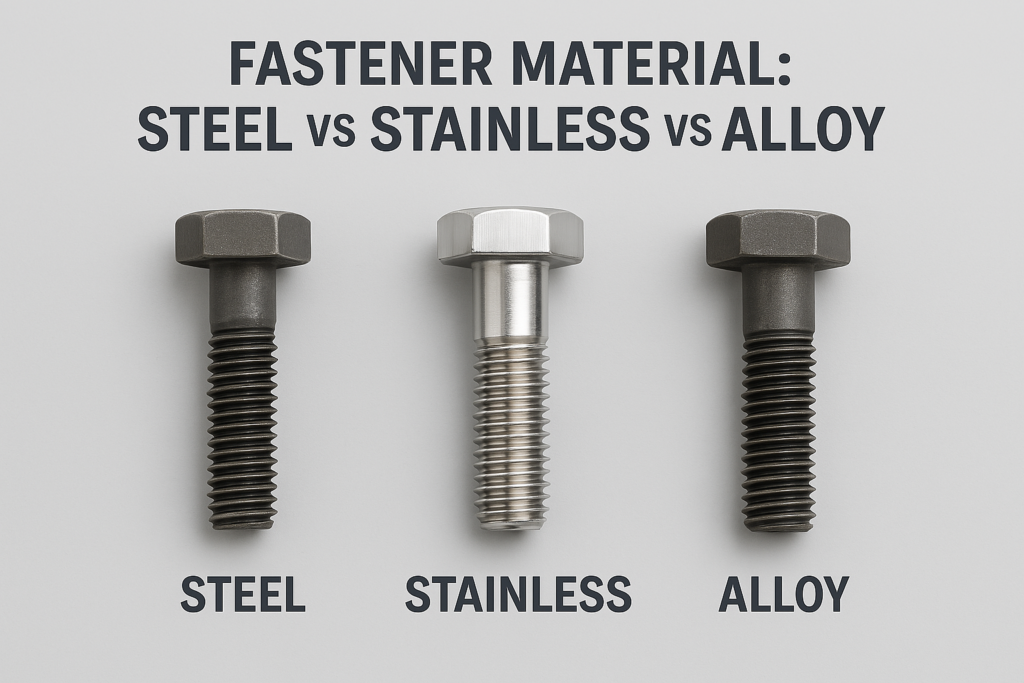
In the industrial fastener sector, the battle for the “perfect” material typically centers on Stainless Steel, Carbon Steel, and Iron. While carbon steel often wins on initial purchase price, Stainless Steel (specifically the 300-series) offers a “downward pressure” on long-term operational risks that other materials cannot match.
1. Core Performance Metrics: Technical Comparison
Understanding the fundamental differences requires looking at the chemistry and physical limits of each material.
| Feature | Cast/Wrought Iron | Carbon Steel (Grade 8.8/10.9) | Stainless Steel (A2-70/A4-80) |
| Corrosion Defense | None (Rapid oxidation) | Dependent on coatings (Zinc/Dacromet) | Self-healing Passive Layer ($Cr_2O_3$) |
| Tensile Strength | Low | Very High (Up to 1200+ MPa) | Medium-High (Up to 800 MPa) |
| Low-Temp Toughness | Extremely Brittle | Brittle at sub-zero temps | Excellent (Cryogenic stability) |
| Maintenance | Constant (Scraping/Painting) | Periodic (Coating inspection) | Minimal (Self-sustaining) |
| Recyclability | Moderate | High | Extremely High (High scrap value) |
2. The Competitive Edge of Stainless Steel
A. The “Self-Healing” Immunity vs. The “Fragile Shell”
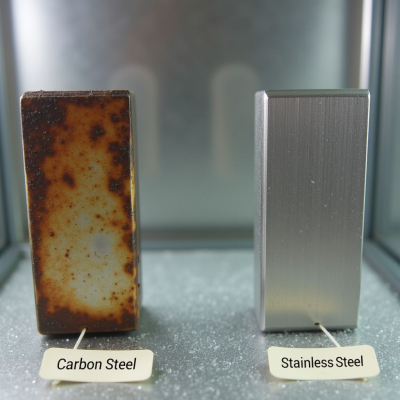
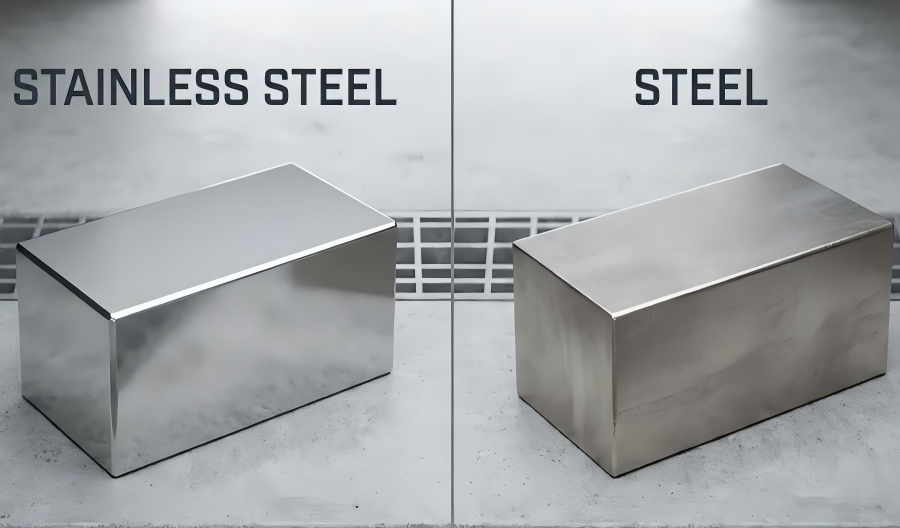
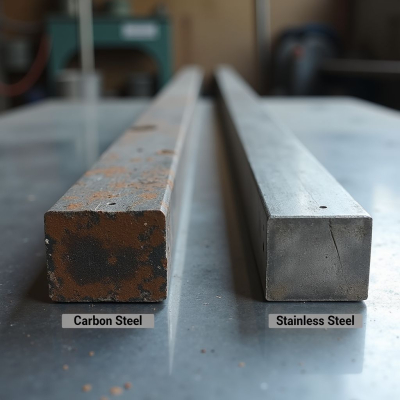
- Carbon Steel/Iron: Their survival depends entirely on a sacrificial or barrier coating. If a bolt or nut is scratched with a wrench during installation, the raw iron atoms are exposed. In the presence of moisture, they oxidize rapidly, creating “expansive rust” that seizes threads and weakens the structure.
- Stainless Steel: Contains at least 10.5% Chromium. This reacts with oxygen to form a dense, transparent layer of Chromium Oxide. If the surface of a screw is scratched, this layer re-generates instantly at the molecular level. It is an internal defense system, not an external coating.
B. Cryogenic and Thermal Stability
- Carbon Steel: Suffers from “Cold Brittleness.” Below $-30^\circ\text{C}$, it can shatter like glass under impact.
- Stainless Steel: Austenitic grades (like SUS316) maintain high ductility and toughness at cryogenic temperatures. Conversely, at high temperatures (up to $800^\circ\text{C}$), stainless steel retains significantly better oxidation resistance than iron or steel, making it the standard for industrial equipment and boiler assemblies.
C. Hygiene and Inertia
For medical devices and food processing, carbon steel is a liability. Iron oxide (rust) is porous and harbors bacteria. Stainless steel’s non-porous, inert surface ensures that no metallic flavors or contaminants are leached into the product, which is why it is the only choice for food-grade rivets and machine screws.
3. Life Cycle Cost (LCC) Analysis: The 2026 Procurement Logic
A professional procurement manager looks past the initial Invoice Price to the Total Cost of Ownership:
- Labor Costs: Replacing a rusted self-tapping screw costs 10x the price of the screw in manual labor and downtime.
- Safety Liabilities: In solar racking or construction, a single failed fastener can lead to structural collapse. Stainless steel is an insurance policy against litigation.
- Residual Value: Stainless steel has a high residual scrap value. A decommissioned SUS304 bolt is a valuable asset; a rusted iron bolt is hazardous waste.
4. 2026 Sustainability: CBAM and ESG Compliance
As the Carbon Border Adjustment Mechanism (CBAM) becomes a global standard, the material choice has environmental consequences:
- Coating Hazards: Carbon steel requires energy-intensive, chemically hazardous plating processes (such as galvanization).
- Carbon Footprint: Our stainless fasteners are produced primarily via Electric Arc Furnaces (EAF) using recycled scrap, offering a cleaner carbon profile than primary iron production from blast furnaces.
5. Final Selection Guide
- Choose SUS316/A4: For marine, chemical, or high-humidity environments where salt or acid is present.
- Choose SUS304/A2: For general outdoor use, food processing, and medical hygiene.
- Choose Carbon Steel: Only for indoor, bone-dry environments where extreme tensile strength (Class 12.9) is the absolute priority over corrosion resistance.
Conclusion: Stainless steel is not just a material; it is a risk mitigation strategy. By choosing stainless washers, nuts, and bolts, you are investing in a maintenance-free future and protecting the structural integrity of your999 most critical assets.
For detailed electrochemical potential charts or laboratory salt spray test results, contact our engineering support team.
Contact us at +86 13451555650 or sales@szbilateral.com.