
In industrial fastening systems, the smallest assembly decision can determine long-term structural reliability.
One of the most overlooked questions in bolted joints is:
Should you tighten the bolt or the nut first?
In high-reliability engineering applications, the answer is clear:
When possible, tighten the nut instead of the bolt.
This principle directly impacts preload accuracy, stress distribution, and long-term joint stability.
Why Torque Value Alone Is Not Reliable
Torque is often misunderstood as a direct indicator of clamping force.
In reality, torque is heavily consumed by friction losses:
- Thread friction: ~50%
- Bearing surface friction: ~40%
- Effective preload: <10%
Key Engineering Insight
Even small variations in friction can cause large preload deviations, making torque an indirect and unstable measurement method.
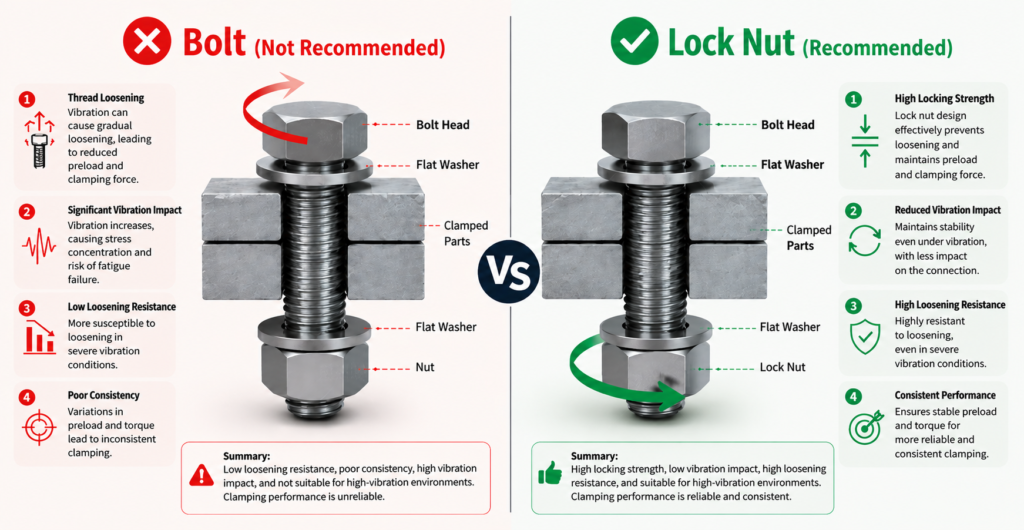
Nut Tightening vs Bolt Tightening
Nut Tightening (Preferred Method)
- Bolt remains stationary
- Only axial tension is generated
- Lower torsional stress
- More stable preload control
Result: Higher consistency in critical assemblies
Bolt Tightening (Less Stable)
- Bolt experiences torsion + tension
- Higher risk of yielding under over-torque
- Preload variability increases
- Sensitive to lubrication changes
Result: Less predictable joint performance
Engineering Reason Behind the Difference
Stress Path Behavior
Nut tightening creates a cleaner load path:
Torque → rotation of nut → axial tension in bolt
Bolt tightening introduces mixed stress:
Torque → torsion + axial load in bolt body
Friction Interface Stability
Nut side typically provides:
- Flatter bearing surface
- More uniform contact pressure
- Lower variability in the friction coefficient
Bolt head side often introduces:
- Edge contact effects
- Surface inconsistency
- Higher friction fluctuation
The Hidden Risk – False Torque Tightening
A major failure mode in field assembly is false tightening.
Causes
1. Over-lubrication
- Reduces friction dramatically
- Leads to over-tensioning
- Causes long-term stress relaxation
2. Contamination or Rust
- Increases friction unpredictably
- Torque is wasted overcoming resistance
- Preload becomes insufficient
Result
Correct torque value ≠ correct clamping force
Best Practice for Industrial Assembly
1. Choose the Correct Tightening Side
- Through-hole joints → tighten nut
- Blind holes → tighten bolt only
2. Use the Dual-Wrench Method
- One side is locked with a backup wrench
- The torque wrench is applied to the tightening side
- Prevents reaction force loss
3. Control Surface Conditions
- Remove rust and debris
- Standardize washer use
- Control the lubrication level
Engineering Applications
This principle is widely applied in:
- Steel structures (bridges, buildings)
- Solar mounting systems
- Wind turbine assemblies
- Heavy machinery
- Automotive chassis connections
In all these systems, preload stability is directly linked to safety and fatigue life.
Related Products
You may also be interested in:
- Stainless Steel Hex Bolts (A2 / A4 Grade)
- Flange Bolts for Structural Connections
- Self-Drilling Screws for Metal Applications
- Solar Mounting Fastener Systems
- Custom OEM Fastener Solutions
Explore more at: szbolts.com
Conclusion
The choice between tightening a bolt or a nut is not a matter of convenience—it is a structural engineering decision.
When design allows, tightening the nut provides:
- Better preload stability
- Lower torsional stress
- Reduced assembly variability
- Improved long-term joint reliability
In high-performance fastening systems, reliability is not defined by torque value alone, but by how consistently that torque is converted into effective clamping force.
FAQ
Why is nut tightening preferred in engineering?
Because it reduces torsional stress on the bolt and improves preload consistency.
Is torque a reliable indicator of clamping force?
No. Most torque is lost to friction and does not directly create preload.
When should I tighten the bolt instead of the nut?
Only in blind-hole or single-side access applications.
What causes bolt joints to loosen over time?
Friction variation, vibration, and improper surface preparation.
Does lubrication improve joint strength?
It depends. Controlled lubrication improves consistency; uncontrolled lubrication reduces accuracy.
Looking for reliable fastening solutions for structural, solar, or industrial applications?
We supply stainless steel fasteners engineered for high-preload stability, corrosion resistance, and long-term performance.
Contact us for OEM/bulk inquiries or technical support.