
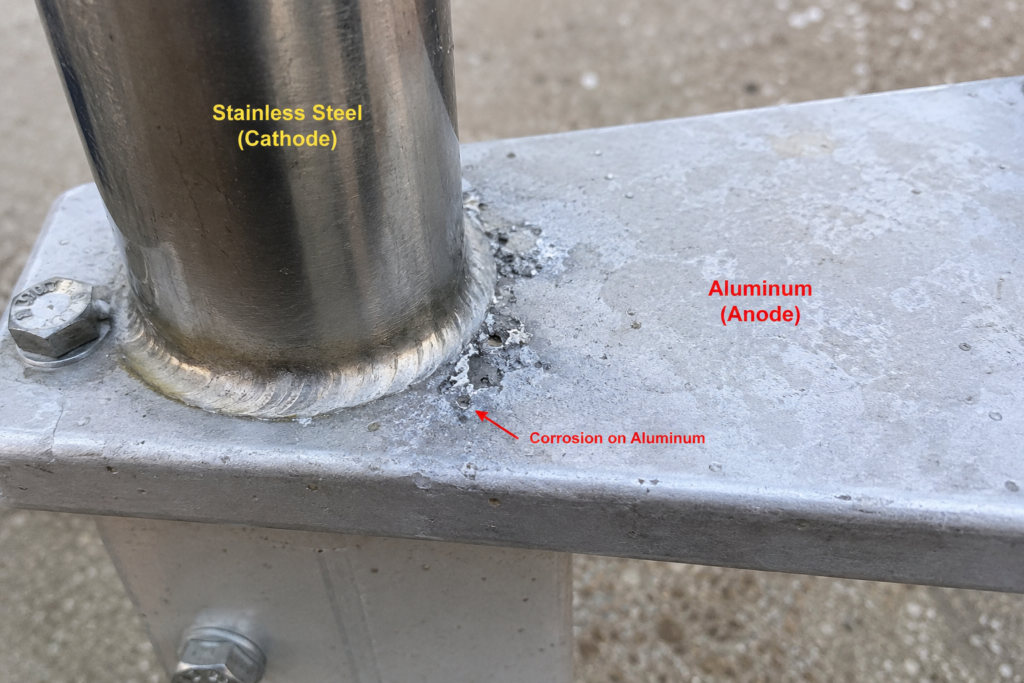
Many people believe aluminum and stainless steel should never be used together because corrosion will inevitably occur.
This is only partially true.
In reality, aluminum and stainless steel are commonly combined in solar mounting systems, roofing, building facades, marine equipment, and transportation applications. Problems arise only when certain conditions allow galvanic corrosion to develop.
Understanding this process is the key to building durable and reliable structures.
Why Does Galvanic Corrosion Occur?
Galvanic corrosion occurs when:
- Aluminum and stainless steel are in direct contact.
- Moisture, water, or salt spray is present.
- An electrical path exists between the metals.
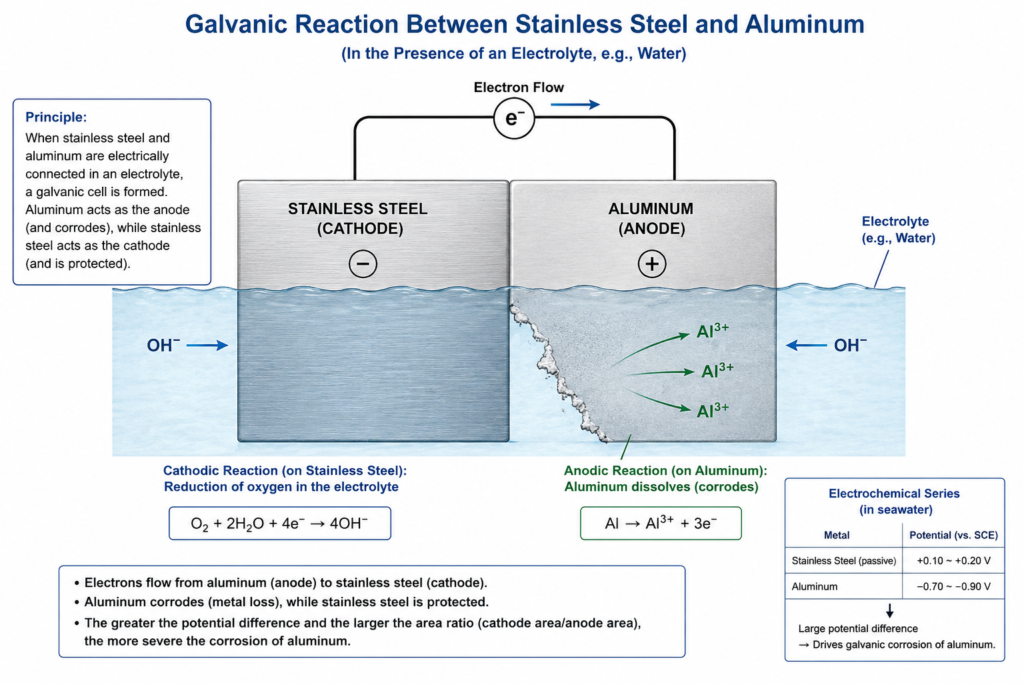
When these conditions are met, a small electrochemical cell forms.
Aluminum acts as the anode and gradually corrodes, while stainless steel becomes the cathode and remains protected.
Typical signs of corrosion include:
- White oxidation powder
- Surface staining
- Pitting
- Material loss
- Reduced structural strength
Without moisture, galvanic corrosion is usually minimal.
What Factors Affect Corrosion Severity?
1. Environment
The surrounding environment has the greatest impact on the corrosion rate.
Dry indoor environments
- Offices
- Equipment rooms
- Warehouses
Generally, present a very low corrosion risk.
Outdoor and coastal environments
- Rainwater
- Condensation
- Salt spray
It greatly accelerates galvanic corrosion, especially near the ocean.
2. Cathode-to-Anode Area Ratio
The size relationship between the two metals is critical.
Large aluminum structure + small stainless steel fastener
This is common in solar mounting systems and generally poses a manageable risk.
Small aluminum component + large stainless steel surface
This is far more aggressive and can cause rapid localized corrosion.
3. Stainless Steel Grade
304 Stainless Steel
Suitable for most outdoor applications.
316 Stainless Steel
Provides better resistance to chloride-rich environments and is preferred for coastal projects.
However, neither grade completely eliminates galvanic corrosion risk.
Common Applications
Aluminum and stainless steel are frequently used together in:
Solar Mounting Systems
- Aluminum rails
- Stainless steel bolts
- Stainless steel clamps
This combination is widely accepted throughout the solar industry.
Doors and Windows
Outdoor aluminum frames often use stainless steel hardware and fasteners.
Marine Equipment
Boats, docks, and offshore structures require additional corrosion protection due to constant exposure to saltwater.
Vehicles and Bicycles
Water, road salt, and changing weather conditions increase corrosion risk.
Real-World Corrosion Risks
Improper aluminum-stainless steel connections have caused failures in:
- Aerospace structures
- Military equipment
- Marine vessels
- Coastal buildings
In most cases, corrosion occurred because moisture entered the connection and no isolation measures were used.
The issue is not the material combination itself, but the lack of corrosion protection.
How to Prevent Galvanic Corrosion
The goal is simple:
Break the galvanic circuit.
1. Physically Isolate the Metals
The most effective solution is to prevent direct contact.
Common materials include:
- Nylon washers
- PTFE washers
- Plastic sleeves
- Rubber gaskets
- Fiberglass spacers
2. Apply Protective Coatings
Protective coatings help separate the metals and block moisture.
Examples include:
- Anodized aluminum
- Geomet-coated fasteners
- Dacromet coatings
- Industrial paint systems
3. Seal Out Moisture
Preventing water from reaching the connection is equally important.
Common solutions:
- Silicone sealants
- Polyurethane sealants
- Polysulfide sealants
- Anti-seize compounds
4. Improve Structural Design
Good design practices can significantly reduce corrosion risk.
Recommended guidelines:
✔ Avoid large stainless steel components attached to small aluminum parts
✔ Eliminate water traps
✔ Ensure proper drainage
✔ Inspect coastal installations regularly
Aluminum Rails and Stainless Steel Bolts in Solar Projects
One of the most common questions in the solar industry is whether aluminum rails and stainless steel fasteners can be safely used together.
The answer is yes.
This combination has become the global standard for photovoltaic mounting systems.
When properly designed and protected, aluminum rails and stainless steel fasteners can provide more than 25 years of service life.
For coastal projects, additional measures are recommended:
- 316 stainless steel fasteners
- Anodized aluminum rails
- Insulating washers
- Waterproof sealing systems
Frequently Asked Questions
Will aluminum and stainless steel always corrode when they touch?
No.
Galvanic corrosion only occurs when moisture and an electrical path are present. In dry environments, corrosion is usually minimal.
How long can aluminum rails and stainless steel bolts last together?
Typical service life:
| Environment | Expected Service Life |
|---|---|
| Indoor | 30+ Years |
| Inland Outdoor | 25+ Years |
| General Outdoor | 20–30 Years |
| Coastal Areas | 15–25 Years |
Proper insulation and sealing can extend service life significantly.
What are the signs of galvanic corrosion?
Common symptoms include:
- White powder deposits
- Pitting corrosion
- Surface discoloration
- Material thinning
- Reduced connection strength
Can corroded aluminum be repaired?
Minor corrosion can often be repaired by cleaning, sanding, and applying protective coatings.
Severely pitted or structurally damaged components should be replaced.
Do stainless steel bolts cause aluminum to rust?
Not exactly.
Aluminum does not produce red rust like steel. Instead, galvanic corrosion causes white oxidation products, pitting, and gradual material loss.
Is 316 stainless steel better than 304 when used with aluminum?
Yes.
316 stainless steel performs better in marine and coastal environments due to its higher resistance to chloride exposure.
However, isolation measures are still recommended.
What is the best way to prevent galvanic corrosion?
Physical isolation is generally the most effective method.
Nylon washers, PTFE spacers, plastic sleeves, and other non-conductive materials prevent direct metal-to-metal contact and interrupt the galvanic circuit.
Can aluminum and stainless steel be used together in solar mounting systems?
Yes.
Aluminum rails and stainless steel fasteners are widely used throughout the solar industry and can operate reliably for decades when proper corrosion protection measures are implemented.
Which metals are most harmful when directly connected to aluminum?
Copper, brass, bronze, and carbon steel generally create a greater galvanic corrosion risk than stainless steel.
Whenever these metals must be connected to aluminum, proper isolation should be used.
Conclusion
Aluminum and stainless steel can safely be used together in solar mounting systems, construction projects, transportation equipment, and marine applications.
The real concern is not the material combination itself, but galvanic corrosion caused by moisture and electrical contact.
By using insulation, protective coatings, sealants, and proper design practices, aluminum and stainless steel structures can achieve decades of reliable service even in demanding outdoor environments.