
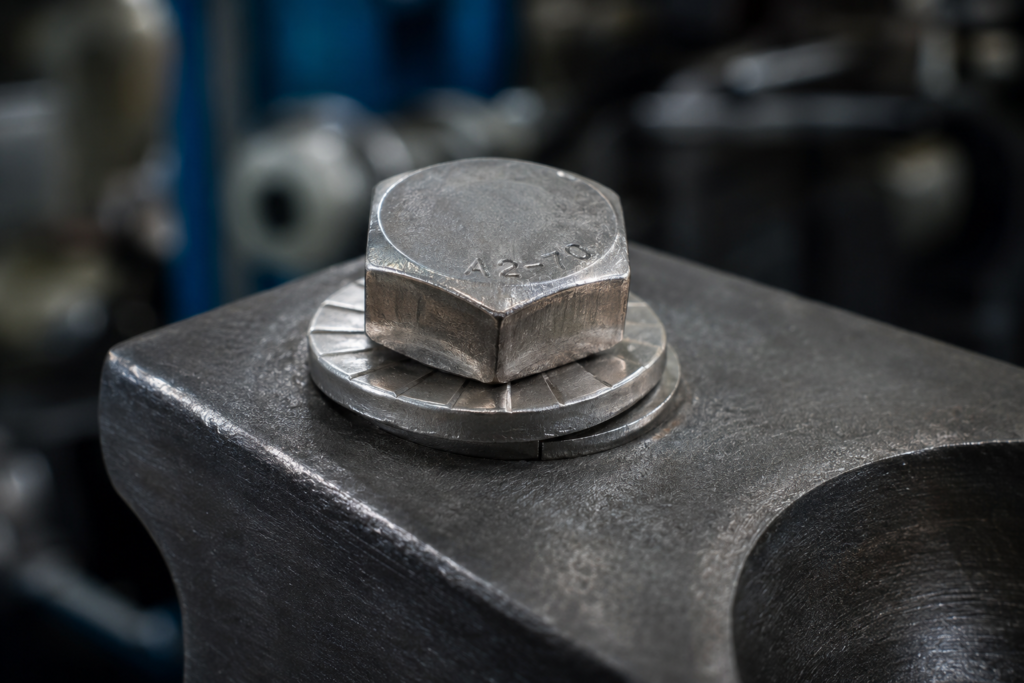
Many maintenance engineers and equipment assemblers ask the same question: to avoid leaving indentations on coated surfaces or precision-finished parts, can a flat washer be added beneath a self-locking washer?
From a technical standpoint, this is not recommended.
This practice disrupts the self-locking washer’s wedge-locking mechanism, reduces connection reliability, and may lead to a loss of preload, ultimately compromising the safety of the entire fastening system.
Why does this issue frequently arise in actual engineering projects?
During our project support work, we frequently encounter customers asking similar questions:
“We don’t want the freshly painted equipment surface to be damaged by the washers. Can we add a flat washer under the self-locking washer?”
This question is particularly common in:
- Photovoltaic mounting systems
- Offshore engineering structures
- Food processing equipment
- Aluminum alloy components
- Stainless steel equipment manufacturing
Because these applications have high requirements for surface quality, corrosion resistance, and long-term reliability, many construction workers attempt to protect the surface by adding flat washers.
However, from a fastening engineering perspective, this practice may directly affect the fastener’s resistance to loosening and increase the risk of loosening during long-term operation.
Why can’t self-locking washers be used with flat washers?
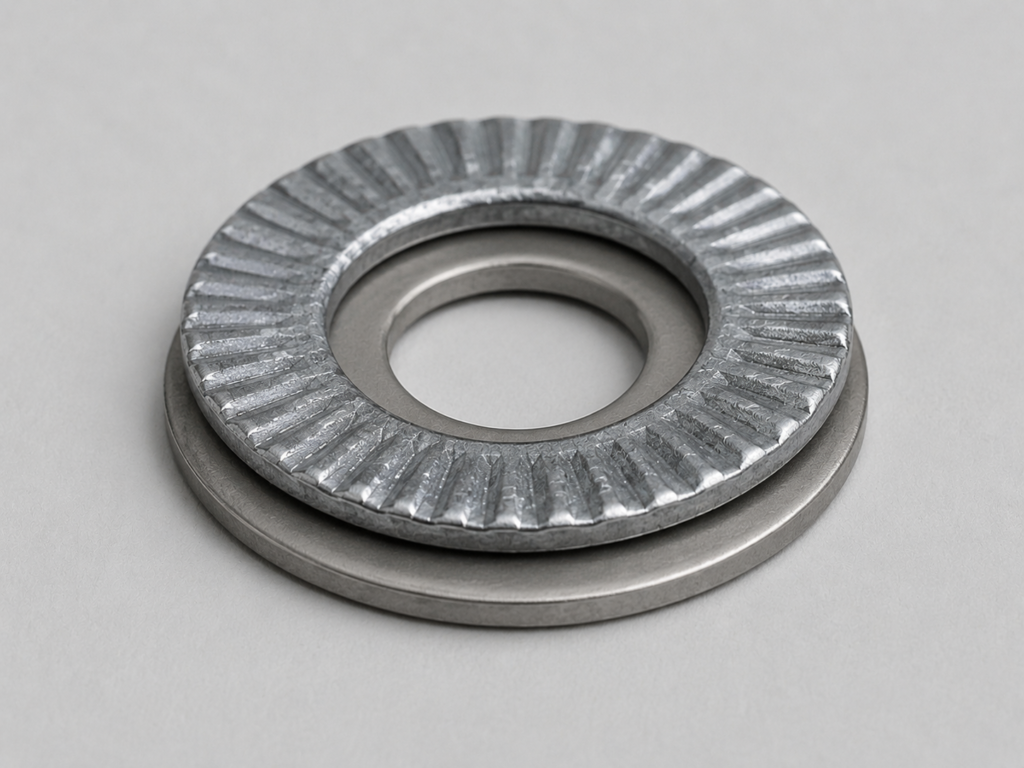
The locking effect of high-performance self-locking washers is not achieved through friction, but rather through a unique wedge-shaped geometry.
When the bolted joint is subjected to vibration or dynamic loads, the wedge-shaped structure generates a lift angle greater than the thread pitch, thereby preventing the bolt or nut from rotating and loosening.
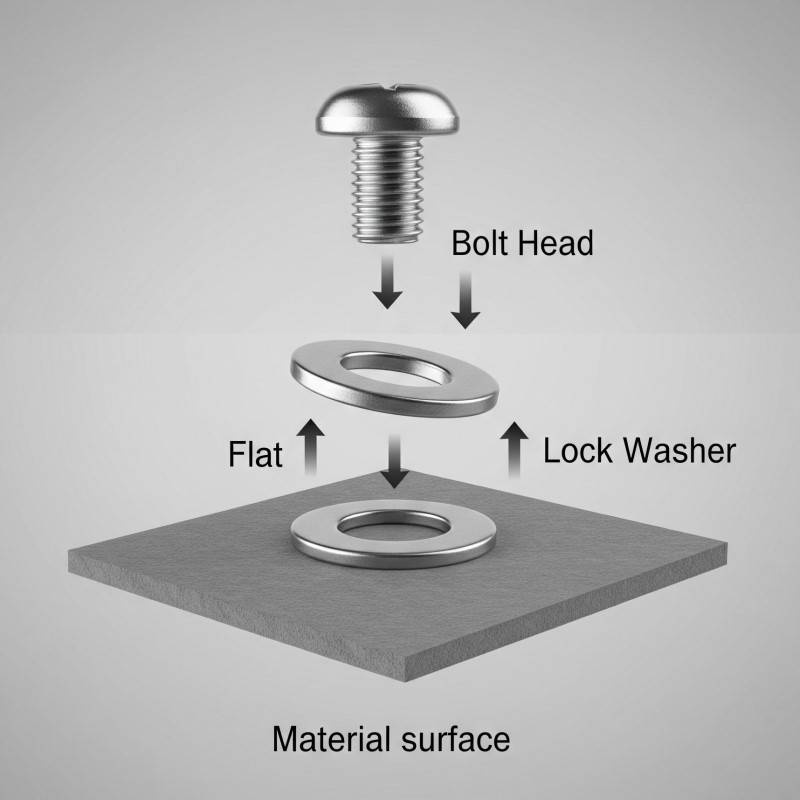
However, when a standard flat washer is added between the workpiece surface and the self-locking washer, an additional free-sliding interface is created.
In this case, although the self-locking washer can lock the flat washer, it cannot prevent the flat washer from rotating relative to the workpiece surface.
Consequences include:
- Gradual loosening of the connection;
- Continuous loss of preload;
- A significant decline in vibration resistance.
- compromised structural stability.
In other words, the locking effect of the self-locking washer is partially or even completely negated.
Failure to prevent loosening is often not due to poor bolt quality
Many users believe: “Bolt loosening must be a product quality issue.”
In fact, in the vast majority of engineering cases, connection failure is not caused by insufficient material strength, but rather by the loss of sufficient preload in the connection system.
Common causes of reduced preload include:
| Cause | Impact on the Connection |
| Settlement of contact surfaces | Decrease in preload |
| Thermal expansion and contraction | Tension Decay |
| Vibration and shock | Nut loosening |
| Washer slippage | Failure to lock |
| Insufficient torque | Insufficient initial clamping force |
When a flat washer is placed between the self-locking washer and the workpiece, it essentially adds an interface where relative displacement can occur, thereby increasing the risk of the connection loosening.
The most common mistake during self-locking washer installation
During actual assembly, many technicians, upon seeing indentations left by the teeth of the lock washer on the surface of freshly painted parts, anodized aluminum parts, or high-value equipment, often instinctively add a flat washer for protection.
This is one of the most common mistakes made when using self-locking washers.
Self-locking washers, which operate on the wedge-locking principle, feature radial teeth on their outer surface. These teeth need to lightly engage the surface of the connected parts to form a reliable mechanical interlock.
Once a standard flat washer is added, this mechanical interlock is lost, and the locking system loses its anchor point.
Consider a high-speed industrial motor:
The torque applied by the bolt must be continuously converted into a stable clamping force. If there is a freely movable flat washer between the mating surfaces, the entire connection system becomes unstable and is more prone to loosening and failure in long-term vibration environments.
What does the Junker Test verify?
In the fastener industry, the Junker Test is widely regarded as one of the most authoritative methods for evaluating anti-loosening performance.
This test simulates real-world operating conditions through lateral vibration and continuously monitors changes in the preload of the fastened joint.
Extensive test results indicate:
Ordinary spring washers rapidly lose their clamping force;
Standard flat washers lack anti-loosening capability.
Wedge-shaped self-locking washers can maintain a high percentage of preload.
Any measure that weakens the mechanical interlock between the washer and the base material will reduce the anti-loosening effect.
This is why most self-locking washer manufacturers explicitly state that it is not recommended to add additional layers of insulation between the washer and the workpiece.
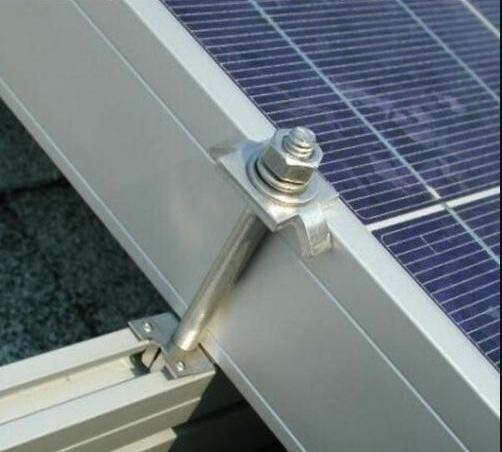
A typical case in the photovoltaic industry
Take rooftop PV mounting systems as an example.
The mounting system is continuously exposed to the following conditions:
Wind loads
Daily temperature fluctuations
Thermal expansion and contraction cycles
Periodic vibrations
The design life of a standard photovoltaic project typically exceeds 20 years.
If connection points become slightly loose:
The risk of module displacement increases.
Fatigue loads on the mounting structure increase.
Maintenance costs rise;
System failure may occur during extreme weather conditions.
Therefore, established PV installation standards typically require:
The use of proven anti-loosening solutions;
Strict control of installation torque.
Install locking components in accordance with manufacturer specifications;
Do not arbitrarily add non-design components.
Are nylon washers or plastic washers suitable?
In application environments where there is a risk of electrochemical corrosion, such as:
Photovoltaic mounting systems;
Offshore engineering structures;
Stainless steel fasteners;
Some users may attempt to add nylon or plastic washers beneath the nut to isolate contact between dissimilar metals.
However, this approach also carries risks.
Plastic materials exhibit significant creep and plastic deformation characteristics, causing them to gradually compress and deform under temperature fluctuations and long-term loads.
After several thermal cycles, the preload of the joint may decrease significantly, leading to loosening of the connection.
Therefore, this approach is not recommended for critical connections requiring sustained clamping force over the long term.
How can you maintain locking performance while protecting the surface?
If your primary concern is surface protection or load distribution, the correct solution is not to add a flat washer, but to use a specially designed large OD washer.
This type of washer:
Increase the load-bearing area.
reduce surface compressive stress;
Reduce localized indentations.
Maintain direct contact between the lock washer and the workpiece surface.
thereby balancing surface protection with anti-loosening performance.
In addition, engineers typically employ the following approaches:
Optimize surface treatment
- Anodizing
- Powder coating
- Hot-dip galvanizing
- Improving surface wear resistance.
Control installation torque
Use a calibrated torque tool to prevent surface damage caused by over-tightening.
Select a professional isolation solution
In environments susceptible to electrochemical corrosion, use a proven insulation design rather than simply adding plastic washers.
Recommendations for Safe and Efficient Installation
To fully leverage the anti-loosening effect of self-locking washers, follow these installation guidelines:
1. Ensure the contact surfaces are suitable for interlocking
The surfaces of the components to be connected must have sufficient load-bearing capacity to allow the washer’s teeth to form a stable mechanical lock.
2. Keep the installation surface clean
Before installation, remove oil, dust, and other contaminants to prevent them from forming a lubricating layer between the washer and the workpiece.
3. Use washers in pairs
Always use original factory-preassembled washer pairs and ensure the wedge-shaped surfaces are in contact during installation.
4. Use specialized models for large holes
For oversized holes, oblong holes, or irregularly shaped holes, select wide-flanged self-locking washers to ensure the locking mechanism is fully supported.
FAQ
Can a flat washer be placed under a self-locking washer?
This is generally not recommended. A flat washer creates an additional sliding surface, reducing the effectiveness of the wedge-locking mechanism.
Will self-locking washers damage painted surfaces?
They will leave some indentations, which are a necessary part of the working principle that creates the mechanical interlock.
Can self-locking washers be reused?
They can usually be reused, but the wear on the teeth and the overall degree of deformation should be checked.
Are self-locking washers mandatory for solar mounting systems?
They are not required for all systems, but in high-vibration or long-term outdoor applications, self-locking washers can significantly improve connection reliability.
What is the difference between a self-locking washer and a spring washer?
Spring washers primarily rely on elastic deformation to generate friction, while self-locking washers resist vibration-induced loosening through a wedge-locking mechanism.
Are stainless steel self-locking washers suitable for coastal environments?
Self-locking washers made of SUS316 material are generally better suited for high-salt-fog and marine environments.
Conclusion
The anti-loosening performance of self-locking washers is based on the wedge-locking principle and mechanical interlocking.
Adding flat washers, nylon washers, or other sliding spacers beneath them may seem to protect the surface. Still, in reality, it weakens or even destroys the locking mechanism, reducing the safety of the connection.
If both surface protection and anti-loosening performance are required, it is recommended to use wide-flanged self-locking washers, proper lubrication, and correct installation techniques, rather than adding extra standard washers.
For high-vibration applications such as photovoltaics, wind power, rail transportation, construction machinery, and marine engineering, maintaining the integrity of the locking system is far more important than avoiding minor surface indentations.
About the Author
Suzhou Bilateral specializes in stainless steel fasteners and industrial connection solutions, with over 15 years of manufacturing and application experience. Our engineering team has long served projects in solar mounting systems, industrial equipment, marine engineering, and building structures, providing professional product selection and technical support to customers worldwide.
Our areas of expertise include:
Stainless Steel Fastener Series
Through continuous product R&D and the accumulation of engineering application experience, we are committed to helping our customers improve connection reliability, reduce maintenance costs, and ensure long-term operational safety.