
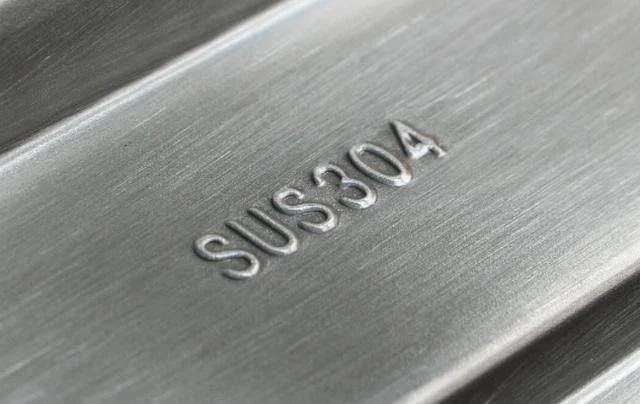
304 stainless steel (UNS S30400 / EN 1.4301 / 06Cr19Ni10) is a typical austenitic stainless steel. Unlike carbon steel or martensitic stainless steel, it cannot be strengthened through conventional quenching and tempering.
The primary purpose of heat treatment for 304 stainless steel is to optimize corrosion resistance and relieve residual stress rather than increase hardness.
The main heat treatment methods for 304 stainless steel are as follows:
1. Solution Annealing (Most Common)
Process:
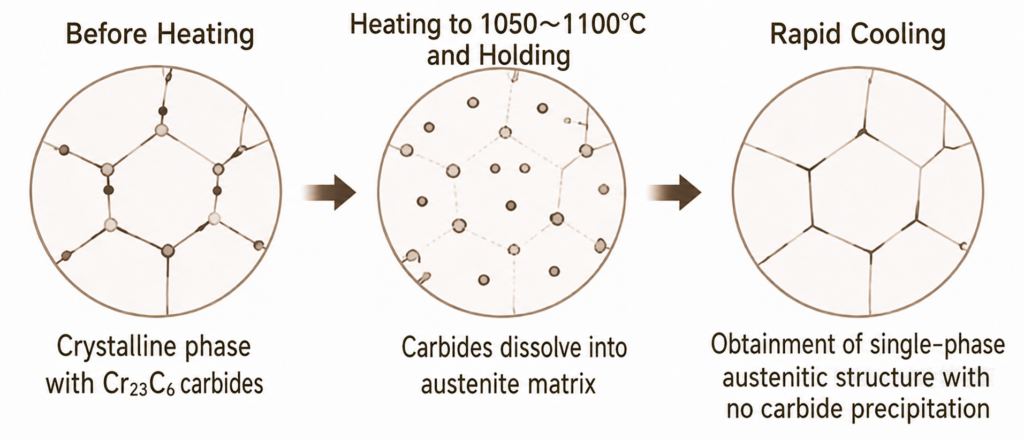
Heat to 1040–1150°C (typically 1050–1100°C), hold at the temperature for a suitable period, and then rapidly cool, usually by water quenching.
Purpose:
To completely dissolve chromium carbides (such as Cr₂₃C₆) into the austenitic matrix and prevent carbide precipitation, resulting in a fully austenitic microstructure.
Benefits:
- Maximizes corrosion resistance
- Reduces hardness
- Improves ductility and toughness
- Enhances formability for cold working
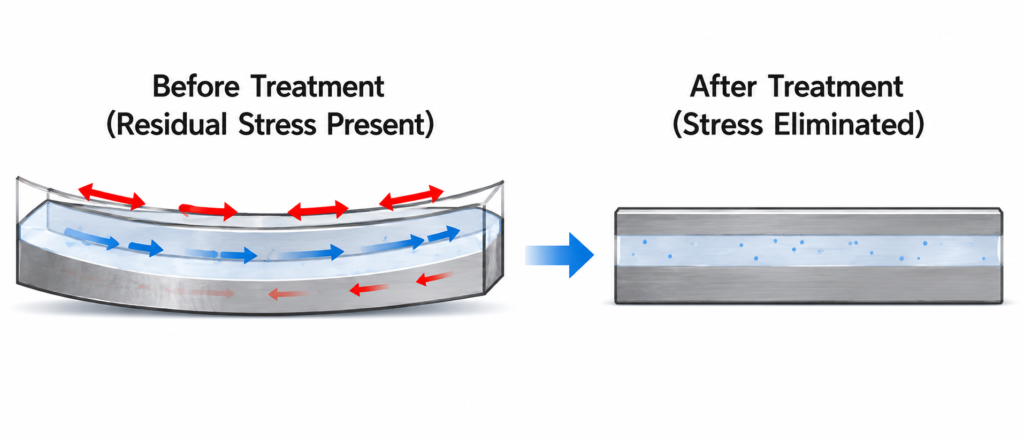
2. Stress Relief Annealing (Removing Forming or Welding Stresses)
For Cold-Worked Components
Recommended temperature: 300–400°C
Purpose: Remove residual stresses generated during cold working operations.
For Welded Components
Recommended temperature: 870–900°C
Purpose: Relieve welding-induced residual stresses.
Benefits
- Minimizes distortion
- Reduces cracking risk
- Improves dimensional stability
Important Note
Prolonged exposure within the temperature range of 450–850°C may cause sensitization, significantly reducing resistance to intergranular corrosion.
3. Stabilization Treatment (For Ti/Nb-Stabilized Grades Such as 304Ti)
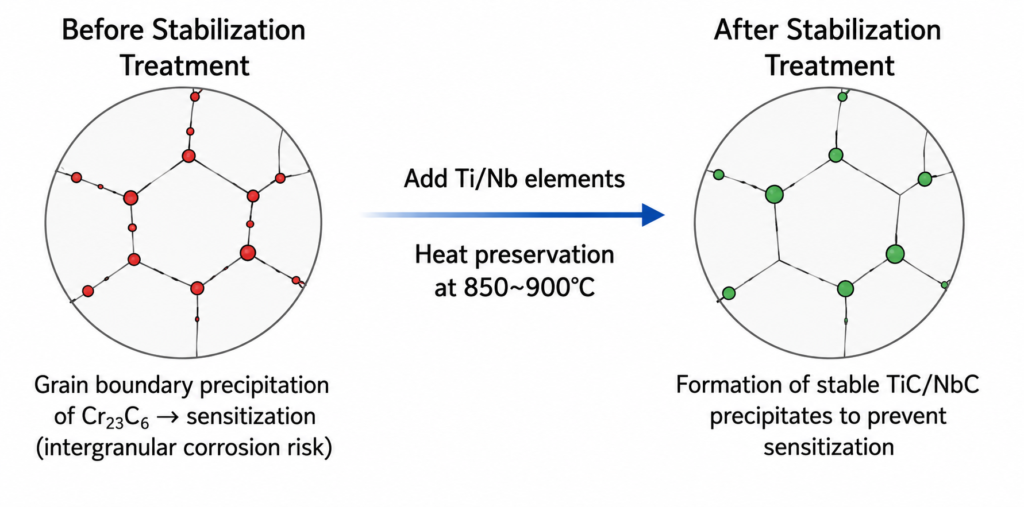
Process: Heat to 850–900°C, hold for an appropriate time, and then cool slowly.
Purpose:
Titanium (Ti) or niobium (Nb) preferentially combines with carbon to form stable carbides, preventing the formation of chromium carbides (Cr₂₃C₆) and reducing the risk of intergranular corrosion.
Applications:
This treatment is generally applied to stabilized grades such as 304Ti and is commonly used for welded structures operating at elevated temperatures.
Standard 304 stainless steel typically does not require stabilization treatment.
Heat Treatments That Cannot Be Applied to 304 Stainless Steel
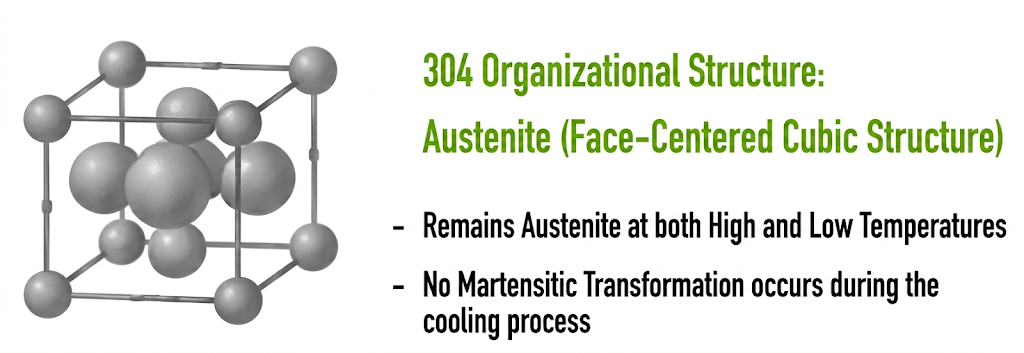
Because 304 stainless steel has an austenitic microstructure, it does not transform into martensite during heating and cooling.
As a result, it cannot be hardened through quenching and tempering. The only practical method for increasing its strength and hardness is cold work hardening, such as:
- Cold rolling
- Cold drawing
- Cold forming
Additionally, prolonged heating within the range of 450–850°C should be avoided because it can lead to sensitization and reduced corrosion resistance.
Key Technical Questions
1. Why Can’t 304 Stainless Steel Be Quenched and Tempered?
Quenching and tempering rely on the formation of martensite during rapid cooling.
Since 304 stainless steel remains austenitic throughout the heating and cooling cycle, no martensitic transformation occurs.
Therefore, hardness cannot be significantly increased through quenching and tempering. Strengthening can only be achieved through cold working processes such as cold rolling and cold drawing.
2. What Is Sensitization and Why Should It Be Avoided?
When 304 stainless steel remains within 450–850°C for an extended period, carbon combines with chromium at grain boundaries to form chromium carbides (Cr₂₃C₆).
This process depletes chromium in adjacent areas, creating a chromium-depleted zone.
Because chromium is essential for corrosion resistance, these depleted regions become vulnerable to attack in corrosive environments, leading to:
- Intergranular corrosion
- Reduced toughness
- Cracking and premature failure
3. Why Is Rapid Cooling Required After Solution Annealing?
Rapid cooling “freezes” the high-temperature austenitic structure and prevents chromium carbides from precipitating during cooling.
This ensures that chromium remains uniformly distributed throughout the material, providing the highest possible corrosion resistance and maintaining a fully austenitic microstructure.
Conclusion
304 stainless steel cannot be hardened through quenching because its austenitic structure does not undergo martensitic transformation. Instead, heat treatment is primarily used to improve corrosion resistance, eliminate residual stresses, and prevent sensitization.
For applications requiring higher strength, 304 stainless steel is typically strengthened through cold working rather than quenching and tempering.